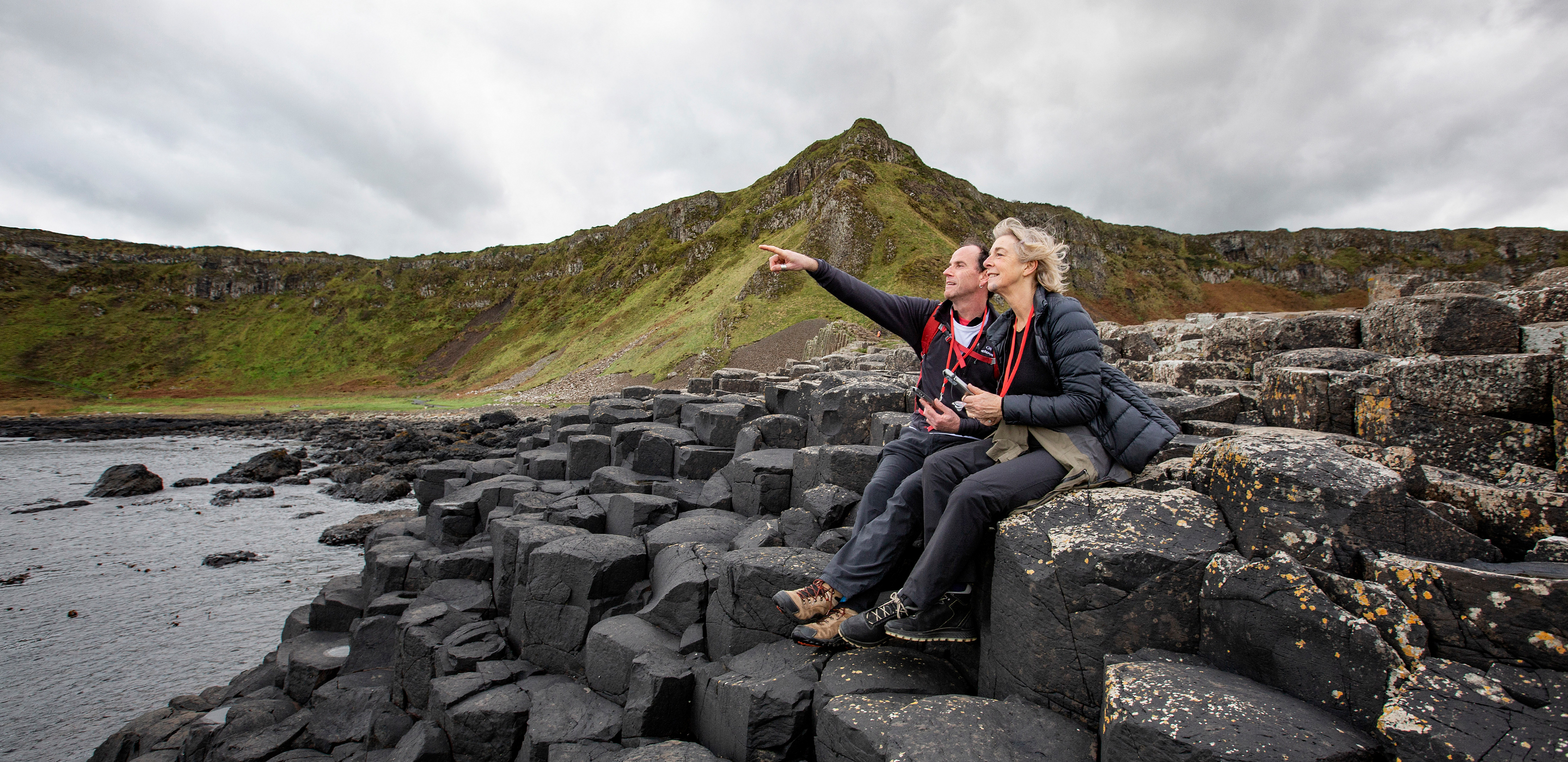
Giant's Causeway: A guide to this UNESCO World Heritage Site, whatever the weather
Outdoor tours
Author: Inge Pett | Posted at: September 2023 | Reading time: 7 minutes
Source: https://www.restauro.de
For three hundred years, the Giant’s Causeway has fascinated scientists and artists alike. The causeway of polygonal basalt columns on the coast of County Antrim is regarded as a symbol of Northern Ireland and is a UNESCO World Heritage Site. This unusual place attracts a correspondingly large number of visitors. To ensure they can move around the site safely, the Berlin-based company tonwelt has developed a dedicated hands-free audio guide.
The Giant’s Causeway in Northern Ireland is a magnet for tourists from all over the world: around one million people visit it each year, with up to 5,000 on peak days. The approximately five-kilometre-long ‘Giant’s Causeway’ has been a UNESCO World Heritage Site since 1986.
The site is deeply rooted in Celtic mythology: according to legend, the Irish giant Fionn mac Cumhaill challenged his Scottish giant Benandonner to a contest of strength. During the contest, Fionn tore a piece from the Antrim coast and used it to build a land bridge to the neighbouring island.
Some 40,000 uniformly shaped, massive black basalt columns stretch along the “A natural site of exceptional beauty” stretching along the cliffs before plunging into the sea. Their size and shape are spectacular: around half of the columns, which are up to twelve metres high, have a hexagonal cross-section. The rock layer is up to 25 metres thick. Researchers believe that the landscape was formed by volcanic activity during the Tertiary period, some 50 to 60 million years ago.
Formations of vertical basalt columns can form when lava cools very slowly and evenly. The columnar structure forms as a result of tension cracks that slowly penetrate the material. These cracks form as the material cools and shrinks, spreading perpendicular to the cooling surface. The volcano whose lava led to the formation of the dam no longer exists; it has been eroded away.
The British National Trust owns and manages the 70-hectare Giant’s Causeway site, which features a network of signposted footpaths leading down to the coast. Much of the area, which is designated as the ‘Causeway Coast Area of Outstanding Natural Beauty’, is a protected nature reserve.
The audio guide, developed by the Berlin-based company tonwelt, introduces the growing number of tourists to the history, geography and significance of the site in an accessible way. “Located right by the roaring sea, this presented a major challenge,” sums up Johannes Maibaum, technical director at tonwelt.
Another challenge was that the client wanted a user interface that would guide visitors both through the visitor centre and along the outdoor path to the water’s edge. “A hands-off audio guide with consistent automatic activation was the obvious solution here,” explains Maibaum. The company developed the “supraGuide ECO”, a device that is quick, safe and intuitive to use – both inside the visitor centre and along the paths to the cliffs, where information about the Giant’s Causeway can be accessed at numbered information points.
The guide also incorporates various existing video stations within the exhibition. This has the advantage of significantly reducing the noise level in the open hall. One visualisation, for example, shows how the movements of tectonic plates led to the unique formation of the rocks. “We provide the content in eleven languages to ensure our visitors get something out of it,” emphasises Alastair Walker, Site Manager at the Giant’s Causeway. Previously, the explanations had only been available in English. “Visitors from all over the world should have an experience worthy of a UNESCO World Heritage Site,” says Walker. He particularly likes the fact that visitors don’t have to hold the guide. Not even in strong winds or on slippery ground. “They can simply let it dangle around their neck and let the impressions of what they’ve seen and learnt sink in.”
This text was originally published in German. The English translation provided here was generated using AI.